







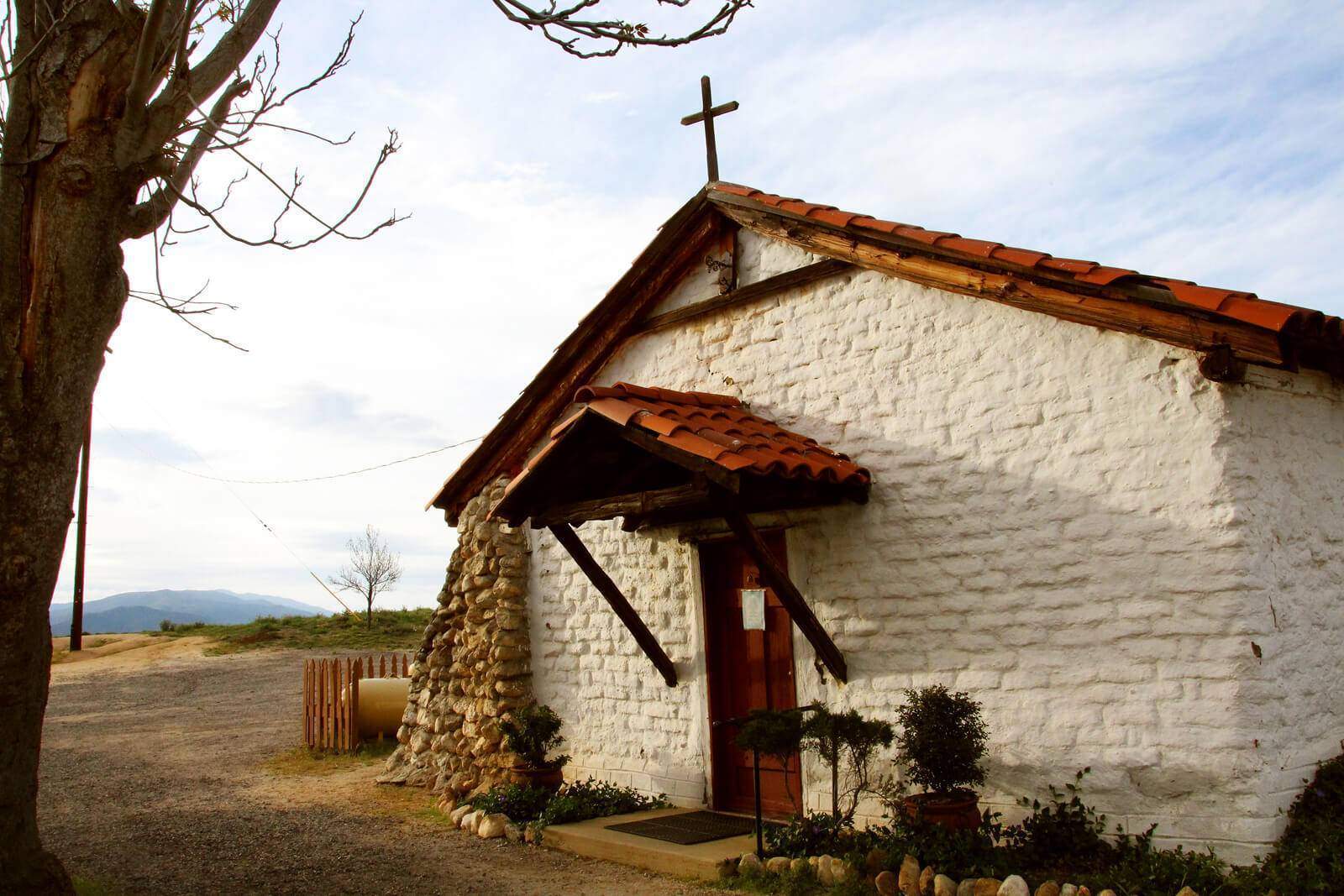

St. Francis of Assisi Chapel
1 Review
Hello everyone! This is a friendly reminder that any of these fun places we may visit, we are a guest at. Please treat both businesses and trails with the utmost respect. We here at Hidden San Diego follow the 'Leave no Trace' mantra, meaning whatever you bring with you comes back with you. If you see trash on a trail, please do your part to help remove it. Remember, we are not picking up trash from another person but instead cleaning up for Mother Nature. Happy adventures!
Hwy 79 & Stage Rd.
Warner Springs, CA 92086
33.285787, -116.636380
Dog-Friendly: Outside, yes Kid-Friendly: Yes

About the St. Francis of Assisi Chapel
This chapel stands beside the cemetery associated with the Cupeño village of Kúpa, where many of their ancestors are buried. It is closely connected to the events surrounding the forced removal of the Cupeño in 1903, sometimes referred to as California’s Trail of Tears. There is a plaque commemorating this event. The land dispute over the Cupeño residents’ ancestral homeland began in 1892, eventually resulting in their forced removal.

History of Warner Springs
The area in which the St. Francis of Assisi Chapel sits is a place of both preserved, natural beauty and great heartache and controversy. Located in Warner Springs.
In 1875, Spaniards began colonizing this area and after Mexico achieved independence, its government granted Juan Jose Warner nearly 45,000 acres of the land in which we now know as Warner Springs. Like most large land-holders in California, forced Native American-labor was relied upon at this time.
The Cupeño had a village in this area called Kúpa and provided much of the workforce for Warner’s cattle ranch. They continued to live on the land throughout the Mexican-American War. According to Julio Ortega, one of the oldest members of the tribe, Warner set aside approximately 16 miles of land surrounding the hot springs as the private domain of the Indians.

Their living condition was observed in 1846 by a US Army Corps of Engineers, describing the state they were living in as being ill-treated. Because of this and the Spanish invasion in general, a Cupeño from Warner’s Ranch named Antonio Garra attempted a revolt. I have written in depth about the failed revolt on this page, which sadly resulted in his death.
In July 1892, former California governor John G. Downey began legal proceedings to evict the Cupeños from the ranch they had been living on. Legal proceedings lasted almost a decade, but eventually went against them. The California Supreme Court ruled against the Cupeño in 1899, and the U.S. Supreme Court upheld that decision on May 13, 1901. The government attempted to purchase land for the Cupeño, but negotiations with the ranch owners were unsuccessful. Theodore Roosevelt intervened by authorizing the formation of a commission in 1902 to help locate and purchase suitable land for their relocation.

Cecilio Blacktooth, Cupeño chief at Agua Caliente, said: “You see that graveyard over there? They are our fathers and grandfathers. You see that eagle nest mountain and rabbit hole mountain? When God made them, he gave us this place. We have always been here. We do not care for any other place. It may be good but it is not ours…this is our home…if Harvey Downey says he owns this place, that is wrong…”
On May 12, 1903, the Cupeño were forcibly removed from their ancestral village of Kúpa and relocated to a reservation in Pala, approximately 40 miles away. Present-day members of the Los Coyotes, San Ygnacio, Santa Ysabel and Mesa Grande bands are among the descendants of the Warner Springs Cupeños.






1Cavers! 1Cavers!
Came across this church by accident. For it’s age it’s in good condition and worth stopping to see. It’s always peaked my interest as to how church’s were built based on their geographic location and the culture of those who built it. The adobe structure and simple wood pews make me feel like Im back in Mexico. It’s very peaceful. A new bathroom was built which was nice.
April 26, 2022